Checking the fuel injectors on your 1998-2003 2.2L Isuzu Rodeo or 1998-2002 2.2L Isuzu Amigo to see if one is causing a cylinder misfire or a rough idle isn't difficult. As a matter of fact, it's something you can do yourself with a few basic tools.
In this tutorial, I'm going to show you how to test the fuel injectors step by step using a multimeter. Your test results will give you a good starting point for diagnosing (and solving) a cylinder misfire or a rough idle condition.
Contents of this tutorial:
ES  You can find this tutorial in Spanish here: Cómo Probar Los Inyectores De Combustible (1998-2003 2.2L Isuzu Rodeo, Amigo) (at: autotecnico-online.com).
APPLIES TO: This tutorial applies to the following vehicles:
- 2.2L Isuzu Amigo: 1998, 1999, 2000.
- 2.2L Isuzu Rodeo: 1998, 1999, 2000, 2001, 2002, 2003.
FUEL INJECTOR CIRCUIT DIAGRAMS:
- Fuel Injector Circuit Wiring Diagram (1998-1999 2.2L Isuzu Rodeo, Amigo).
- Fuel Injector Circuit Wiring Diagram (2000-2003 2.2L Isuzu Rodeo, Amigo).
Symptoms Of A Bad Fuel Injector
Each fuel injector on your 1998-2003 2.2L Isuzu Rodeo or 1998-2000 2.2L Isuzu Amigo has one job: deliver the right amount of fuel to its cylinder. When one injector quits working or isn't delivering fuel correctly, that cylinder won't pull its weight.
A fuel injector can cause problems in several different ways:
- Open or shorted internal coil: The injector has an electrical coil inside it. If that coil develops an open circuit or a short circuit, the injector will not open and spray fuel.
- Restricted or clogged injector: The injector may still work electrically, but fuel deposits can restrict its flow or affect its spray pattern. As a result, that cylinder gets too little fuel.
- Injector circuit problem: A problem in the injector wiring or the PCM's injector control circuit can keep the injector from pulsing on and off like it should.
- Leaking injector: An injector can leak fuel when it should be closed. This can flood one cylinder, cause a rich-running condition, and make the engine hard to start.
When an injector is not spraying fuel into its cylinder, the engine will usually let you know. Here are some of the symptoms you may notice:
- Rough idle: The engine shakes or idles unevenly.
- Misfire: One cylinder is dead or weak, especially at idle.
- Lack of power: The engine feels like it has no pep when you accelerate.
- Hesitation: The engine stumbles when you step on the accelerator.
- Check engine light: Since this vehicle is OBD II equipped, a fuel-injector-related misfire can set one or more of these trouble codes:
- P0300: Random/Multiple Cylinder Misfire Detected.
- P0301: Cylinder #1 Misfire Detected.
- P0302: Cylinder #2 Misfire Detected.
- P0303: Cylinder #3 Misfire Detected.
- P0304: Cylinder #4 Misfire Detected.
In this tutorial, I'll show you how to test the fuel injector's internal coil to find out if it has failed. I'll also show you a basic way to find out if a clogged injector is behind a dead-cylinder misfire.
Checking The Injector's Internal Resistance
Fuel injectors are electro-mechanical valves. They're designed to last a long time, but they open and close thousands of times as the engine runs. Sooner or later, one can fail.
Inside every injector is a small electrical winding that creates the magnetic force needed to pull the injector's pintle open. If that winding develops an electrical problem, the injector won't open and won't spray fuel into its cylinder.
The cool thing is that we can check the condition of the injector's internal winding with a multimeter. We're looking for either of these two problems:
- Open circuit: The injector's internal winding is broken. Your multimeter will display OL (infinite resistance).
- Short circuit: The injector's internal winding is shorted. Your multimeter will show a resistance reading at or near 0 Ohms.
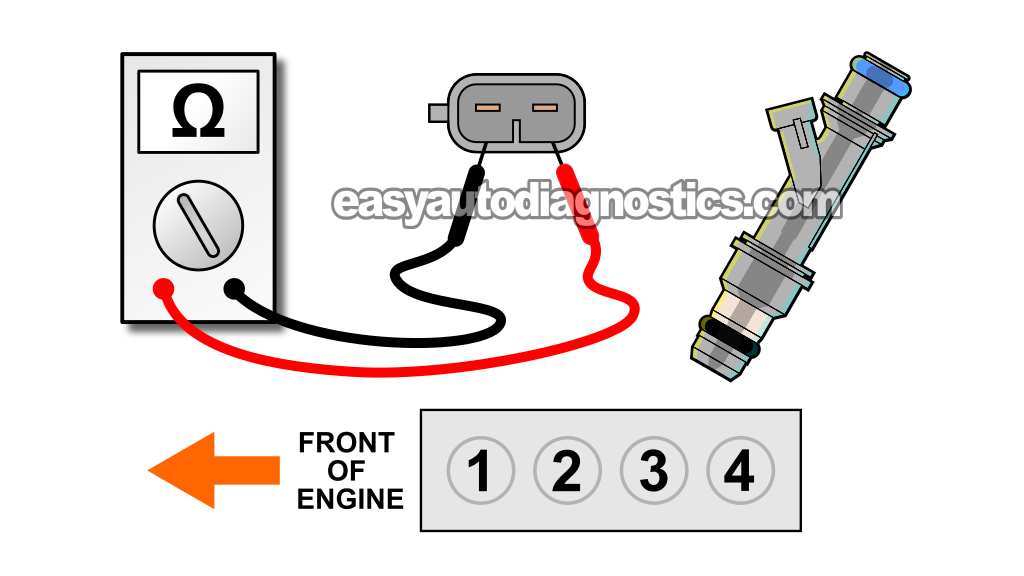
On the 2.2L Isuzu Rodeo and Amigo, a good injector should measure between 11.8 and 12.6 Ohms with the injector at about 50-95° F (10-35° C) [in other words: ambient temperature]. All four injectors should also have very similar resistance readings.
NOTE: Don't have a multimeter or need to upgrade yours? Check out my recommendation: Tekpower TP8268 AC/DC Auto/Manual Range Digital Multimeter (Amazon affiliate link).
Alright, here are the steps:
- 1
Disconnect the fuel injectors from their electrical connectors.
NOTE: The illustration above will help you identify the cylinder # the fuel injector belongs to. - 2
Place your multimeter in Ohms (Ω) mode.
- 3
Measure the resistance of the fuel injector across its two male spade terminals with the multimeter test leads.
- 4
Your multimeter should show a reading between 11.8 and 12.6 Ohms.
- 5
Write down the resistance value that your multimeter records for the specific fuel injector you're testing.
The illustration above will help you identify the cylinder # the fuel injector belongs to. - 6
Repeat steps 3 through 5 on the remaining fuel injectors.
Let's take a look at what your fuel injector resistance test results mean:
CASE 1: All four injectors measured within specification. This tells you that none of the fuel injectors has an open or shorted internal winding.
In other words, the injectors are OK electrically. The readings should be between 11.8 and 12.6 Ohms, with all four readings close to each other. If you got those results, you can cross an internal injector-coil failure off the list.
Keep in mind, however, that this test does not tell us whether an injector is clogged. An injector can have a good resistance reading but still not spray enough fuel into its cylinder. If you suspect that one is restricted, go to: How To Find The Bad Or Clogged Fuel Injector.
CASE 2: One injector measured outside of specification or completely different from the other three. This result confirms that the injector has an internal electrical problem.
If the injector reads OL, its internal winding is open. If it reads at or near 0 Ohms, it is shorted. Either way, that injector is bad and needs to be replaced.
How To Find The Bad Or Clogged Fuel Injector
When you're looking at the engine and trying to find the cause of a cylinder misfire, it can feel like you're trying to find a needle in a haystack. A bad or clogged fuel injector is one possible cause, but so are several other things.
The good news is that we don't have to guess. By testing the ignition system, checking the injector, and paying attention to the results we get along the way, we can narrow the problem down one step at a time.
In this section, I'll show you the troubleshooting approach I use to find out whether a fuel injector is causing the misfire on your 2.2L Isuzu Rodeo or Amigo—or whether the real problem is somewhere else.
- Start by identifying the cylinder that is misfiring.
- This is where we've got to start. Until you know which cylinder is dead, you won't know which fuel injector to test.
- If the check engine light is on, a cylinder-specific misfire code can point you in the right direction:
- P0301: Cylinder #1 Misfire.
- P0302: Cylinder #2 Misfire.
- P0303: Cylinder #3 Misfire.
- P0304: Cylinder #4 Misfire.
- If you only have a P0300 code, you'll need to do a cylinder balance test or another test to identify the misfiring cylinder.
- Once you know which cylinder is misfiring, check that it has spark.
- A fuel injector is not the only thing that can cause a dead cylinder. A bad spark plug, spark plug wire, or ignition coil can cause the exact same type of misfire.
- Use a dedicated spark tester to check for spark at the spark plug wire of the misfiring cylinder.
- Check the spark plug well: Remove the spark plug wire and make sure the boot and spark plug are not soaked in engine oil or coolant.
- Inspect the spark plug: Remove it and check for cracks, carbon tracks, heavy carbon buildup, or a fuel-soaked tip. Any one of these problems can cause a misfire.
- Here's a real life case study on carbon tracks and how they can cause a misfire: Carbon Tracks Are A Common Cause Of Ignition Misfires.
- The goal of this step is to eliminate the ignition system as the cause of the misfire. Once you've confirmed that the cylinder has good spark, then we can focus on its fuel injector.
- If the misfiring cylinder has spark, our next step is to check its compression.
- A cylinder can have good spark and a good fuel injector but still misfire if it has a mechanical problem causing low compression.
- This is why a compression test is one of the most important (and most commonly skipped) tests when diagnosing a rough idle or cylinder misfire.
- I'll show you how to do the compression test here:
- Check for an injector pulse with a Noid light.
- If the ignition system and engine compression both checked out OK, we're gonna check whether the fuel injector is being commanded to open.
- A Noid light plugs into the fuel injector connector. It flashes while the engine is cranking if the PCM is pulsing the injector circuit.
- If the Noid light flashes, the injector is receiving its activation signal. If it does not flash, the problem is in the injector circuit, its wiring, or the PCM's control of that circuit.
- This article will show you the basics of using one: How To Use A Noid Light And Where To Buy It.
- Swap the suspect injector with the injector next to it.
- This is a quick and practical way to find out whether an injector is clogged or mechanically faulty. I only do this test after the following have checked out OK:
- Ignition system: The misfiring cylinder has good spark.
- Engine compression: The cylinder's compression reading is close to the other three cylinders.
- Injector resistance: The injector's internal winding has passed the resistance test.
- Injector pulse: The injector connector has a pulsing signal during cranking or while the engine is running.
- Move the suspect injector to the cylinder next to it, then clear the misfire code and run the engine again.
- If the misfire moves with the injector: That injector is clogged or mechanically defective and needs to be cleaned or replaced.
- If the misfire stays in the same cylinder: The injector is not the cause of the problem. We've got to keep looking for the cause of the misfire.
- This is a quick and practical way to find out whether an injector is clogged or mechanically faulty. I only do this test after the following have checked out OK:
Finding a bad or clogged fuel injector on your 2.2L Isuzu Rodeo or Amigo can take a little time, but it's definitely doable. The key is to first identify the cylinder that is misfiring, then test one thing at a time instead of guessing.
This troubleshooting approach has saved my lunch more than a few times. It'll help you avoid replacing a fuel injector that isn't bad and point you toward the real cause of the misfire.
More 2.2L Isuzu Rodeo And Amigo Diagnostic Tutorials.
You can find a complete list of 2.2L Isuzu Rodeo and Amigo tutorials in this index:
Here's a small sample of the tutorials you'll find in the index:
- How To Test The TPS (1998-2003 2.2L Isuzu Amigo And Rodeo).
- How To Test For A Blown Head Gasket (1998-2003 2.2L Isuzu Amigo And Rodeo).
- How To Test The Fuel Pump (1998-2003 2.2L Isuzu Rodeo, Amigo).
- How To Test Engine Compression (1998-2003 2.2L Isuzu Amigo And Rodeo).

If this info saved the day, buy me a beer!