
If you're trying to figure out whether the fuel pump on your 1998-2003 2.2L Isuzu Rodeo or 1998-2002 2.2L Isuzu Amigo is actually working correctly, a fuel pressure test is the way to find out.
What makes testing fuel pump pressure so easy on the 2.2L Isuzu Rodeo and Amigo is that the fuel injector rail comes equipped with a Schrader valve. This gives us a place to connect a fuel pressure test gauge and check whether the fuel pump is producing the correct amount of fuel pressure.
In this tutorial, I'm going to show you how to do this test step by step and explain how to interpret your fuel pressure test result. You'll quickly find out if a fuel pressure problem is causing an engine cranks-but-does-not-start issue, a hard-start problem, or a lack-of-power complaint.
I'm also going to show you a quick way to find out whether the engine isn't starting due to a lack of fuel by doing a starting fluid test.
Contents of this tutorial:
ES  You can find this tutorial in Spanish here: Cómo Probar La Bomba De Combustible (1998-2003 2.2L Isuzu Rodeo, Amigo) (at: autotecnico-online.com).
APPLIES TO: This tutorial applies to the following vehicles:
- 2.2L Isuzu Amigo: 1998, 1999, 2000.
- 2.2L Isuzu Rodeo: 1998, 1999, 2000, 2001, 2002, 2003.
IMPORTANT: Gasoline is highly flammable! Take all necessary safety precautions, be alert, be careful. Starting fluid and gasoline can ignite very easily.
FUEL PUMP CIRCUIT DIAGRAMS:
- Fuel Pump Circuit Wiring Diagram (1998-1999 2.2L Isuzu Rodeo, Amigo).
- Fuel Pump Circuit Wiring Diagram (2000-2003 2.2L Isuzu Rodeo, Amigo).
Symptoms Of A Bad Fuel Pump
On your 1998-2003 2.2L Isuzu Rodeo or 1998-2000 2.2L Isuzu Amigo, the fuel pump can fail completely or it can get weak enough to cause driveability problems. Here are some more specifics:
- The fuel pump stops working: When the fuel pump quits, it doesn't send any fuel to the fuel injectors. The result is an engine that cranks but does not start.
- The fuel pump gets weak: A weak pump can still produce some fuel pressure, but not enough when the engine needs more fuel. This is when you'll usually run into starting, stalling, and lack-of-power problems.
A weak fuel pump can cause several different symptoms. The thing to keep in mind is that these same symptoms can be caused by other problems too. That's why we've got to test the fuel pressure instead of guessing and replacing parts.
- Hard starting: The engine cranks longer than normal before it starts.
- Starts, then dies: The engine starts but stalls a few seconds later.
- Engine stalls under load: The engine may run fine at idle, but as soon as you put it in Drive and step on the accelerator, it stalls. It may also run fine while you're coasting down the road, but start having problems as soon as you drive uphill.
- Lack of power: The vehicle feels sluggish or has no power when you step on the accelerator.
- Backfire through the intake: The engine pops or backfires through the intake manifold when accelerating.
- Lean trouble codes: The check engine light may be on with one or more lean air/fuel mixture trouble codes.
Where To Buy A Fuel Pressure Gauge
A fuel pressure gauge is one of those tools that can save you a lot of time and money. Instead of wondering whether the fuel pump is doing its job, you can connect the gauge and see exactly what kind of fuel pressure it is producing.
The cool thing is that you don't need an expensive professional gauge for this test. Most auto parts stores sell fuel pressure test kits, and you can usually find them online for a reasonable price too. The following are the fuel pressure gauges I recommend:


Disclosure: As an Amazon Associate, I earn from qualifying purchases. Buying through these links helps support this site at no extra cost to you. Thanks for your support —it really means a lot!
Fuel Pressure Specifications
The fuel pressure specifications on the 1998-2003 2.2L Isuzu Rodeo and 1998-2000 2.2L Amigo are:
| Year | KOEO | KOER |
|---|---|---|
| 1998-2003 | 41-55 PSI | not given |
- KOEO: Key On Engine OFF.
- KOER: Key On Engine Running.
NOTE: With the key on and the engine running (KOER), intake manifold vacuum acts on the fuel pressure regulator and fuel pressure should drop by 3 to 15 PSI.
TEST 1: Fuel Pressure Test With Gauge
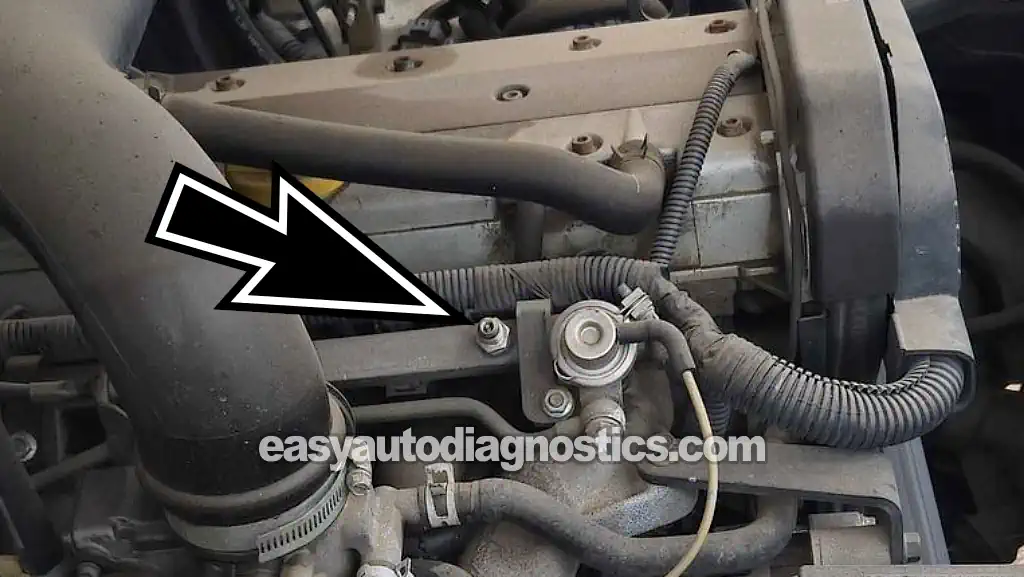
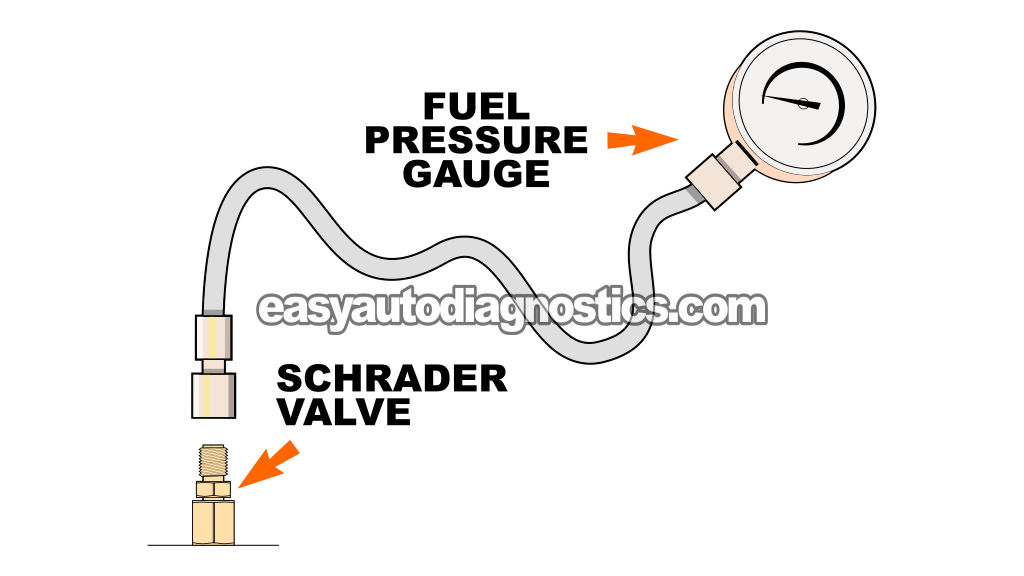
Testing the fuel pump pressure on your 2.2L Isuzu Rodeo or Amigo is pretty simple. The fuel injector rail has a fuel pressure test port (Schrader valve), so we can connect a fuel pressure gauge right there (see photo 1 of 2 above).
The test port has the same basic design as a tire valve stem. Once its protective cap is removed, the fuel pressure gauge screws onto it.
Before connecting the gauge, make sure the engine is completely cool. We're gonna be working around gasoline, so don't smoke, don't work near an open flame, and keep a fire extinguisher nearby.
OK, here's how to check the fuel pump pressure:
- 1
Remove the cap from the fuel pressure test port and place a shop towel underneath it. The towel will catch the small amount of fuel that may come out when you connect the gauge.
- 2
Connect the fuel pressure gauge to the Schrader valve. Tighten it by hand only.
- 3
Turn the key to the ON position, but do not crank the engine.
Take a moment to check the gauge connection for fuel leaks.
If fuel is leaking, turn the key off and correct the problem before continuing.
If there are no leaks, go to the next step. - 4
Cycle the key ON and OFF several times while you watch the fuel pressure gauge, but don't crank or start the engine.
Turn the key to the ON position and leave it there for 3 seconds. Then turn the key to the OFF position and wait 3 seconds before turning it back to ON.
Repeat this ON-for-3-seconds, OFF-for-3-seconds cycle several times. Each time you turn the key ON, the PCM will run the fuel pump for about 2 seconds and then shut it off.
Cycling the key this way builds fuel pressure without starting the engine and gives us our Key On Engine Off (KOEO) fuel pressure reading. - 5
Your fuel pressure test gauge should read a fuel pressure somewhere between 41 to 55 PSI.
Let's take a look at what your fuel pressure gauge reading means:
CASE 1: The gauge shows 0 PSI. This tells you that no fuel is reaching the fuel injector rail. If the engine cranks but does not start, this 0 PSI reading explains why: the engine isn't getting any fuel.
A 0 PSI reading usually means the fuel pump has failed, but we've got to make sure the pump is actually being powered before replacing it. A blown fuel pump fuse, a bad fuel pump relay, an open wire, or a bad ground can keep a good fuel pump from running.
Our next step is to check that the fuel pump is receiving battery power and Ground when the engine is cranking. If it is receiving power and Ground but the gauge still reads 0 PSI, then the fuel pump is bad.
CASE 2: The gauge registers the correct fuel pressure specification. This result tells you that the fuel pump is doing its job and supplying the fuel injectors with enough fuel pressure.
If your 2.2L Isuzu Rodeo or Amigo cranks but does not start, the no-start problem is being caused by something else. With this test result, you can cross the fuel pump off the list of possible causes.
TEST 2: Using Starting Fluid

The starting fluid test is a quick way to find out if an engine no-start problem is being caused by a lack of fuel. It doesn't replace a fuel pressure test, but it can point us in the right direction when you don't have a fuel pressure gauge available.
If the engine starts and runs for a few seconds on starting fluid, we know the engine can run. This usually means the no-start problem is related to a fuel delivery issue.
Before doing this test, make sure you have verified that all four spark plugs are receiving spark. Starting fluid will not help an engine start if it has no ignition spark.
OK, here's how to do the starting fluid test:
- 1
Loosen the intake air duct at the throttle body. You only need enough room to spray the starting fluid into the throttle body. Leave the duct in place, since we're gonna reconnect it right away.
- 2
Open the throttle plate by hand and spray a good amount of starting fluid into the throttle body bore.
- 3
Immediately reconnect the intake air duct to the throttle body. You don't need to tighten the hose clamp for this test.
IMPORTANT: Reconnecting the air duct is a safety precaution. If the engine backfires through the intake manifold, the air duct helps contain the backfire. - 4
Have your helper crank the engine.
- 5
You'll get one of these two results:
1.) The engine starts, runs for a few seconds, and then dies.
2.) The engine cranks but does not start.
Let's interpret the result of your starting fluid test:
CASE 1: The engine started, ran briefly, and then died. This is a strong indication that the engine is not getting fuel from the fuel system.
The engine ran on the starting fluid you sprayed into the throttle body, but it died as soon as that starting fluid was used up. This tells us that spark and engine mechanical condition are OK, and that we need to focus on the fuel delivery system.
A bad fuel pump is a common cause of this result, but don't replace it just yet. The cool thing is that we can verify the diagnosis by checking fuel pressure with a gauge.
CASE 2: The engine did not start on starting fluid. This result tells you that the no-start problem is probably not being caused by a lack of fuel.
Something else is keeping the engine from starting. It could be a no-spark condition, an engine mechanical problem, or another issue. The thing to keep in mind is that this result is only valid if you confirmed that all four spark plug wires are delivering spark before doing the test.
More 2.2L Isuzu Rodeo And Amigo Diagnostic Tutorials
You can find a complete list of 2.2L Isuzu Rodeo and Amigo tutorials in this index:
Here's a small sample of the tutorials you'll find in the index:
- How To Test The TPS (1998-2003 2.2L Isuzu Amigo And Rodeo).
- How To Test For A Blown Head Gasket (1998-2003 2.2L Isuzu Amigo And Rodeo).
- How To Test Engine Compression (1998-2003 2.2L Isuzu Amigo And Rodeo).
- How To Test The Fuel Injectors (1998-2003 2.2L Isuzu Rodeo, Amigo).

If this info saved the day, buy me a beer!
