
Testing the ignition coil assembly and ignition control module (ICM) on the 1998-2003 2.2L Isuzu Rodeo and 1998-2000 2.2L Isuzu Amigo isn't difficult.
The cool thing is that you don't need any expensive or exotic diagnostic equipment to do it.
In this tutorial, I'm going to show you how to find out whether the ignition coil/ICM assembly is behind an engine no-start problem or a cylinder misfire.
I'll explain each test step by step so you can quickly narrow down the problem without replacing parts unnecessarily.
Contents of this tutorial:
- Symptoms Of A Bad Ignition Coil Assembly Or ICM.
- What Tools Do I Need To Test The Ignition Coil?
- TEST 1: Testing For Spark At The Spark Plug Wire.
- TEST 2: Testing For Spark At The Ignition Coil Pack.
- TEST 3: Testing For Spark At The Ignition Coil Pack (Non-Paired Cylinders).
- TEST 4: Testing For Spark At The Ignition Coil Pack (Paired Cylinders).
- TEST 5: Making Sure The Coil Pack Is Getting IGN 12 Volts.
- TEST 6: Making Sure The Coil Pack Is Getting Ground.
- TEST 7: Checking Coil A And B Activation Signals.
- Other Things That Can Cause A Misfire.
- More 2.2L Isuzu Rodeo And Amigo Diagnostic Tutorials.
ES  You can find this tutorial in Spanish here: Cómo Probar Las Bobinas De Encendido (1998-2003 2.2L Isuzu Rodeo, Amigo) (at: autotecnico-online.com).
APPLIES TO: This tutorial applies to the following vehicles:
- 2.2L Isuzu Amigo: 1998, 1999, 2000.
- 2.2L Isuzu Rodeo: 1998, 1999, 2000, 2001, 2002, 2003.
ICM CIRCUIT WIRING DIAGRAMS:
- Ignition Control Module Circuit Wiring Diagram (1998-1999 2.2L Isuzu Rodeo, Amigo).
- Ignition Control Module Circuit Wiring Diagram (2000-2003 2.2L Isuzu Rodeo, Amigo).
Symptoms Of A Bad Ignition Coil Assembly Or ICM
The ignition coil assembly on your 2.2L Isuzu Rodeo or Amigo contains two important ignition components: the ignition coils that create the high-voltage spark and the ignition control module (ICM) that controls when those coils fire.
When either the ignition coil or the integrated ICM fails, the spark plugs may not receive the spark they need to ignite the air/fuel mixture inside the cylinders. If there's no spark at all, the engine won't start. If only one coil or one part of the ICM fails, the engine may start but run rough and lack power.
Since this is a waste-spark ignition system, a problem with one coil or one section of the ICM can affect two cylinders at the same time. And when the ignition coil assembly, the internal ICM, or the spark plug wires begin to fail, the engine will usually let you know by showing one or more of these symptoms:
- Rough idle and stalling.
- Lack of power on acceleration.
- Bad gas mileage.
- The engine cranks but won't start.
- Misfire trouble codes —the check engine light illuminates with one or more of the following codes:
- P0300: Random Cylinder Misfire.
- P0301: Cylinder #1 Misfire.
- P0302: Cylinder #2 Misfire.
- P0303: Cylinder #3 Misfire.
- P0304: Cylinder #4 Misfire.
- Ignition coil trouble codes —the check engine light illuminates with one or more of the following codes:
- P0351: Ignition Coil "A" Circuit Malfunction.
- P0352: Ignition Coil "A" Circuit Malfunction.
- Rotten egg smell from the exhaust from unburned fuel entering the catalytic converter and creating a sulfur smell.
What Tools Do I Need To Test The Ignition Coil?
To find out whether the ignition coil pack assembly on your Isuzu Rodeo or Amigo is good or bad, you're gonna need a few basic tools:
- A multimeter. If you don't have one, this is the one I use and recommend: Tekpower TP8268 AC/DC Auto/Manual Range Digital Multimeter (Amazon affiliate link).
- An LED light. This LED light will help is confirm that the PCM is activating the ignition control module (within the coil pack assembly) in TEST 7. If you don't have one, this is the one I recommend: Oznium Flush Mount 12V LED Light (Amazon affiliate link).
- A spark tester. This tool is a must have. If you don't have one and need to buy one, I recommend the HEI spark tester. It's accurate and the one I always use: OTC 6589 Electronic Ignition Spark Tester (Amazon affiliate link).
- Battery jump start cables to help you Ground the spark tester to the battery negative (-) terminal.
- A helper. Someone to help you crank the engine during the tests.
TEST 1: Testing For Spark At The Spark Plug Wire
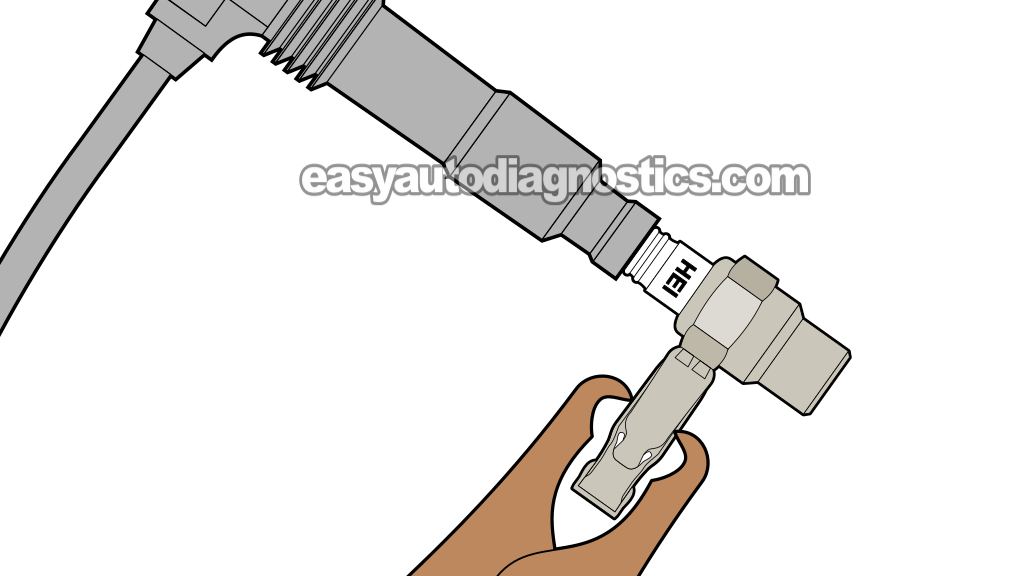
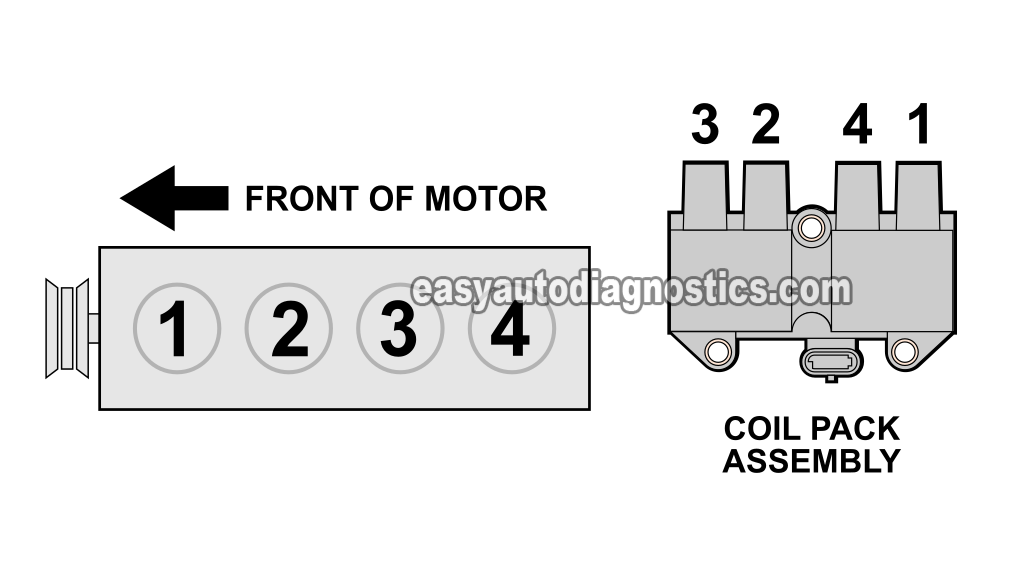
The first thing we're gonna do is check all four spark plug wires for spark. And for this test, it's critical that you use a dedicated spark tester.
I personally use the OTC HEI spark tester because it simply works without having to make any adjustments to it. But it doesn't really matter which type of spark tester you use, as long as it is a dedicated spark tester.
You may have seen people pull a spark plug wire off the spark plug and see if they can hear the spark jump to the side of the spark plug tube. I don't recommend doing that. A dedicated spark tester will give you a safer and much more reliable test result.
Alright, let's get started.
- 1
Remove the spark plug wire (high-tension cable) from the cylinder #1 spark plug.
- 2
Attach a spark tester to the high-tension wire.
- 3
Connect the spark tester to the battery negative (-) terminal using a battery jump start cable, as shown in the photo above.
- 4
Have your helper crank the engine while you observe the spark tester from a safe distance.
NOTE: The engine may or may not start —either way, be careful. - 5
You're gonna' get one of two results: Spark or NO spark.
- 6
Disconnect the spark tester from the wire and reconnect the wire to its spark plug.
- 7
Repeat the spark test on the remaining spark plug wires.
IMPORTANT: Read the following options carefully to interpret your NO SPARK results. Keep in mind that the coil pack contains two separate ignition coils, and each one fires two paired cylinders (1 and 4, or 2 and 3). So, if you find no spark on two wires, check whether they belong to a paired set or to unpaired cylinders (for example: 1 and 3, 2 and 4, or 1 and 2).
CASE 1: All four spark plug wires produce spark. This tells you that the ignition coil assembly is creating spark and that the spark plug wires are carrying it to the spark plugs.
If your Isuzu Rodeo or Amigo still has a cylinder misfire, the ignition coil assembly and spark plug wires are not causing the problem. We've got to look at something else, such as the spark plugs, fuel injectors, or engine compression. For more information, go to: Other Things That Can Cause A Misfire.
CASE 2: One spark plug wire does not produce spark. This result tells us that either the spark plug wire is bad or the ignition coil assembly is not producing spark from that particular tower.
TEST 2 will help us separate these two possibilities. Go to: TEST 2: Testing For Spark At The Ignition Coil Pack.
CASE 3: Two spark plug wires have no spark, and they belong to the same paired cylinders—either cylinders 1 and 4 or cylinders 2 and 3. This result usually points to a problem with one of the ignition coils inside the ignition coil assembly. However, both spark plug wires could also be faulty.
To separate these possibilities, we'll test for spark directly at the two ignition coil towers that feed those paired cylinders. Go to: TEST 4: Testing For Spark At The Ignition Coil Pack (Paired Cylinders).
CASE 4: Two spark plug wires have no spark, but they do not belong to the same paired cylinders. This result may point to two bad spark plug wires, a problem with the ignition coil assembly, or both problems at the same time.
Our next step is to check for spark directly at the ignition coil towers connected to those two wires. Go to: TEST 3: Testing For Spark At The Ignition Coil Pack (Non-Paired Cylinders).
CASE 5: None of the spark plug wires produce spark. This usually means the ignition coil assembly has lost its IGN power feed, or the crankshaft position (CKP) sensor has failed and the PCM is no longer triggering the ignition system.
Our next step is to make sure the ignition coil assembly is receiving its 12-Volt IGN power supply. Go to: TEST 5: Making Sure The Coil Pack Is Getting IGN 12 Volts.
TEST 2: Testing For Spark At The Ignition Coil Pack
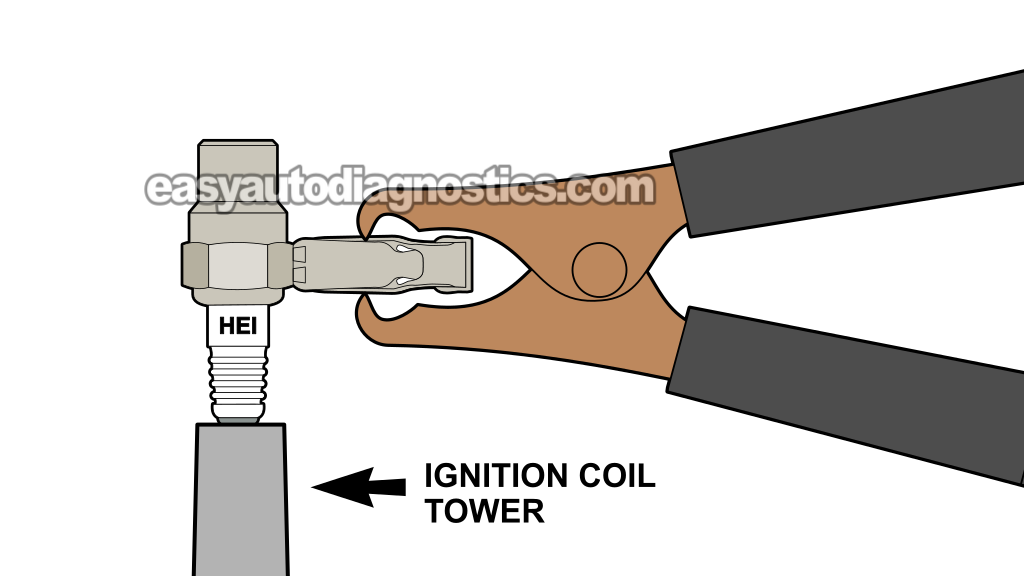
If TEST 1 showed that only one spark plug wire was not producing spark, our next step is to find out whether the problem is in the spark plug wire or in the ignition coil assembly.
We can do this pretty easily. Disconnect the non-sparking spark plug wire from its ignition coil tower, then use the spark tester to check for spark directly at that tower.
Alright, let's begin:
- 1
Remove the spark plug wire that did not fire off spark from the coil pack.
- 2
Place the spark tester directly on the coil pack tower of the spark plug wire you just removed (see the example in the photo above).
- 3
Connect the spark tester to the battery negative (-) terminal with a battery jump start cable.
- 4
Have your helper crank the engine.
CAUTION: The engine may start, so be careful. - 5
You're gonna' get one of two results: Spark or NO spark.
Let's find out what it all means:
CASE 1: The ignition coil tower produced spark. That's the result we want. It tells us that the ignition coil is capable of producing spark and that the problem is in the spark plug wire.
In this case, the spark plug wire is bad. I recommend replacing the complete set of spark plug wires so the new wires have the same service life.
CASE 2: The ignition coil tower did not produce spark. This confirms that the ignition coil assembly is not producing spark from that tower. That's why the spark plug wire failed the spark test in TEST 1.
Replacing the ignition coil assembly should restore spark to that cylinder. When buying the replacement, stick with the original-equipment part or a quality assembly from a reputable manufacturer. Avoid the cheapest no-name replacements, because they can create more ignition problems than they solve.
TEST 3: Testing For Spark At The Ignition Coil Pack (Non-Paired Cylinders)
NOTE: This section applies only if TEST 1 showed that two spark plug wires were not producing spark and those two wires belong to different cylinder pairs.
Now we've got to find out whether the problem is being caused by the spark plug wires, the ignition coil assembly, or one of each. We'll do that by checking the ignition coil tower connected to each non-sparking wire, one at a time.
Once both towers have been tested, your results will tell you whether the problem is in the wires, the ignition coil assembly, or both.
NOTE: Remember, the paired cylinders are 1 and 4, and 2 and 3. Each pair receives spark from the same ignition coil inside the assembly. If both non-sparking wires belong to the same pair —cylinders 1 and 4 or cylinders 2 and 3— skip this section and go to: TEST 4: Testing For Spark At The Ignition Coil Pack (Paired Cylinders).
OK, let's get the ball rolling:
- 1
Remove the spark plug wire that did not spark from the coil pack.
- 2
Place the spark tester directly on the coil pack tower for that wire (see the example in the photo above).
- 3
Connect the spark tester to the battery negative (-) terminal using a battery jump start cable.
- 4
Have your helper crank the engine.
CAUTION: The engine may start, so be careful. - 5
You'll see one of two results: Spark or NO spark.
- 6
Remove the spark tester and reconnect the wire to its coil pack tower.
- 7
Repeat the same spark test on the other coil pack tower —the one that connects to the second non-sparking wire you identified in TEST 1.
Let's see what your spark test result is telling us:
CASE 1: Only one of the two ignition coil towers produced spark. This result gives us two important conclusions, but the second one depends on what happened during TEST 1:
- The ignition coil assembly is bad: One of the ignition coils is producing spark, but the other one is not.
- One spark plug wire is also bad: This applies only to the spark plug wire connected to the tower that did produce spark. Since that tower produced spark during this test, but the same wire did not produce spark during TEST 1, that wire is bad.
In this case, replace the ignition coil assembly and the complete set of spark plug wires.
CASE 2: Both ignition coil towers produced spark. This is the result we want. It tells us that the ignition coil assembly is working and that the reason both spark plug wires failed to produce spark in TEST 1 is because the wires themselves are bad. Replace the complete set of spark plug wires with a new set.
CASE 3: Neither ignition coil tower produced spark. This result means that the ignition coil assembly is toast. Replace the ignition coil to solve the no-spark issue.